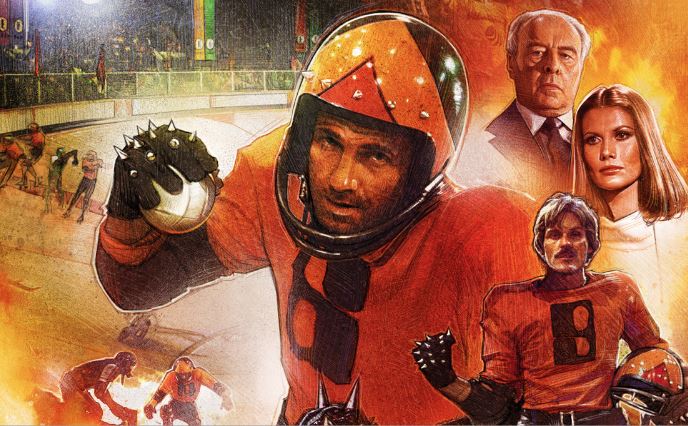
“Rollerball” came and went in 1975 without any great notice. There was some nonsensical existential media drama when some of the stuntmen in the movie reportedly wanted to continue playing the game after filming was complete. Some media outlets warned that this type of behavior was exactly the kind of thing the movie warned against. The downfall of western society seemed to be in the balance (for some over-concerned talking heads anyway.)
Newflash: Western society didn’t fall in 1975. It kept on plugging away, not knowing it had close it had come to the brink of dissolution.
I didn’t get around to seeing “Rollerball” till sometime in the 80’s. A close friend had seen seen it in 75 and had great things to say about it.
Let’s remember that in 75 there was only one way to see a movie how it was meant to be seen; in the theater. If you missed it, you were out of luck. It might come on TV but it would be cut to shreds.
When I did get round to seeing it, the movie certainly made an impression on me. Yet it wasn’t a particularly clear impression. Sure, I loved the action, the sports sequences. But there was something else.
For the longest time I didn’t really know why I liked the movie so much. I just knew that there was some very important (to me) message.
One of the things I did like about the movie is that while there’s plenty of dialogue, it’s not really a talky film. There are lots of moments that feature imagery, movement, and violence.
The film was criticized (and rightfully so) at the time for being guilty of promoting the same kind of sensational sports violence of which it was supposed to be itself critical.
A case could easily be made that there was simply no other way to tell the story. That seems very evident.
Set in a vague, not-to-distant future, the nations of the world have gone away, replaced with global corporations. Rollerball is (apparently) the only surviving professional sport. It is a brutal and violent game in which injury and death are common, almost expected.
James Caan plays Jonathon E, the world’s most successful Rollerball champion. He has beaten the odds and flourished in the game.
But now the corporations want him out and he does not understand why.
After a lot of repeated viewings and consideration, I came to understand the two main reasons for my outright adoration for this movie:
1. The message: (Spoiler Alert!) Jonathon prevails because he will not give in, compromise, or give up. He can’t lose because he won’t lose. In the end, he is faced with the disgust and horror of what the game actually means, it’s actual purpose. Regardless, he chooses to continue. He will not be neutralized. His message is the success of the talented and committed individual over the system. This is the message that hits home every time.
2. The game itself; Several complete Rollerball games are played and they are easily some of the most exciting action sequences in film. I can’t recall how many times I’ve started the movie with the intent of watching one or two scenes, only to be swept way with the story for the umpteenth time. It’s that great of a movie. (to me anyway)
It’s very interesting that the movie seems all but forgotten. You won’t see it mentioned in any great detail in many (if any) of the SF or fantasy film essays or encyclopedia’s of the era. Those who do mention it refer to it as a substandard misfire at best if not an outright waste of time.
To me, it’s much more and I expect it always will be.

