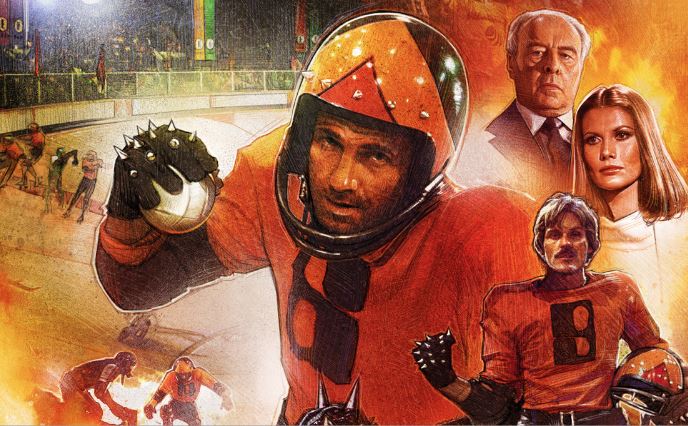
I love “Rollerball” (1975) and I’m not ashamed to admit it.

rollerball

“Rollerball” came and went in 1975 without any great notice. There was some nonsensical existential media drama when some of the stuntmen in the movie reportedly wanted to continue playing the game after filming was complete. Some media outlets warned that this type of behavior was exactly the kind of thing the movie warned against. The downfall of western society seemed to be in the balance (for some over-concerned talking heads anyway.)

Newflash: Western society didn’t fall in 1975. It kept on plugging away, not knowing  it had close it had come to the brink of dissolution.

I didn’t get around to seeing “Rollerball” till sometime in the 80’s. A close friend had seen seen it in 75 and had great things to say about it.

Let’s remember that in 75 there was only one way to see a movie how it was meant to be seen; in the theater. If you missed it, you were out of luck. It might come on TV but it would be cut to shreds.

When I did get round to seeing it, the movie certainly made an impression on me. Yet it wasn’t a particularly clear impression. Sure, I loved the action, the sports sequences. But there was something else.

For the longest time I didn’t really know why I liked the movie so much.  I just knew that there was some very important (to me) message.

One of the things I did like about the movie is that while there’s plenty of dialogue, it’s not really a talky film.  There are lots of moments that feature imagery, movement, and violence.

The film was criticized (and rightfully so) at the time for being guilty of promoting the same kind of sensational sports violence of which it was supposed to be itself critical.

A case could easily be made that there was simply no other way to tell the story.  That seems very evident.

Set in a vague, not-to-distant future, the nations of the world have gone away, replaced with global corporations.  Rollerball is (apparently) the only surviving professional sport. It is a brutal and violent game in which injury and death are common, almost expected.

James Caan plays Jonathon E, the world’s most successful Rollerball champion.  He has beaten the odds and flourished in the game.

But now the corporations want him out and he does not understand why.

After a lot of repeated viewings and consideration, I came to understand the two main reasons for my outright adoration for this movie:

1. The message: (Spoiler Alert!) Jonathon prevails because he will not give in, compromise, or give up. He can’t lose because he won’t lose. In the end, he is faced with the disgust and horror of what the game actually means, it’s actual purpose. Regardless, he chooses to continue.  He will not be neutralized. His message is the success of the talented and committed individual over the system. This is the message that hits home every time.

2. The game itself; Several complete Rollerball games are played and they are easily some of the most exciting action sequences in film. I can’t recall how many times I’ve started the movie with the intent of watching one or two scenes, only to be swept way with the story for the umpteenth time. It’s that great of a movie. (to me anyway)

It’s very interesting that the movie seems all but forgotten. You won’t see it mentioned in any great detail in many (if any) of the SF or fantasy film essays or encyclopedia’s of the era. Those who do mention it refer to it as a substandard misfire at best if not an outright waste of time.

To me, it’s much more and I expect it always will be.
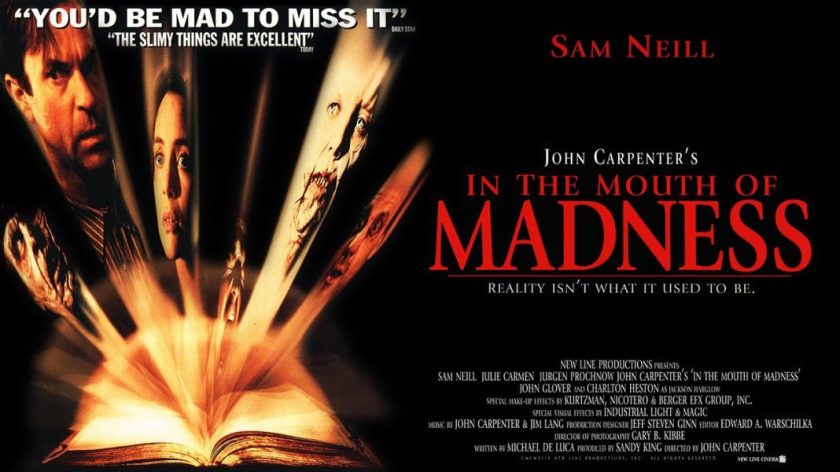


“In The Mouth Of Madness”: Masterpiece or Mess?

In-the-Mouth-of-Madness

The internet streaming service Shudder recently “Live streamed” (Their words of questionable accuracy) “The Last Drive In”, a 24 plus hour-long marathon of notable horror films chosen and with commentary by Joe Bob Briggs (The quasi-redneck crap movie reviewer persona embedded in John Bloom‘s body.)

I love (some) crap movies and Joe Bob Briggs so I navigated to the Shudder site a bit after the start time.   Shudder has a handy Xbox app and I was attempting to use that to view the stream.

The service seemed to be working fine.  Logged in, I navigated to the live feed.

Or tried to.

The feed just kept buffering and finally bailed with some arcane error. Another attempt caused the app to freeze.  I restarted it but couldn’t get it to connect.

I then tried visiting the website on my media computer.  The site would come up but just sat on a buffering screen.

Checking their Facebook page made it clear this wasn’t just my problem.  It seemed no one could get it to work.

Under normal circumstances this might have caused my head to explode.  But I had partaken of some really excellent herb and I was in a really nice place where these kind of frustrations seemed oh so very trivial.

It started working a few hours later and I enjoyed the marathon a little that Friday night and throughout the next day.

So what does that have to do with John Carpenter’s “In The Mouth Of Madness”?
Good question.

One of the movie’s streamed was Stuart Gordon‘s “The Reanimator”.  Mr. Briggs called this movie the best movie version of any H.P. Lovecraft story to date.
I really don’t have a big issue with that statement.  It is an excellent movie.  One might make a case for “Dagon”, also directed by Mr. Gordon, but overall “The Reanimator” is the better movie and is pretty damn faithful to the Lovecraft story.

But it did (for some reason) spur me to consider other movies, in particular movies inspired in some way by Lovecraft.

And that brings me to “In the Mouth Of Madness”.  Not based in any way on a Lovecraft story but obviously a homage to the Lovecraftian theme of old or elder gods banished from our world long, long ago and always searching, scratching, and clawing for a way back.

I’ve seen the movie at least twice before.  I remember liking but not loving it.
Seemed like a good time to give it another chance.

Through the wondrous blessing of the internet and various options I was soon watching a Blu-Ray quality digital copy of the movie.

(Full disclosure: I had again partaken of the excellent herb and I was in a great place to watch a scary movie.)

The premise of the movie is that a best selling horror author has gone missing just before his latest and greatest book was supposed to be completed and delivered. His publisher hires an insurance investigator to look for him.

Some movies, in particular horror or fantasy films, benefit greatly from viewing them not as a faithful reporting of actual reality but as a dream, vision, nightmare, or some other experience that isn’t necessarily grounded in objective reality. This perspective is extremely useful in the full enjoyment and appreciation of some movies and absolutely necessary for others. (“Videodrome” and “Suspiria” come to mind.)

“In The Mouth Of Madness” is best experienced using that perspective. It does have a strong story, but the things the viewer sees and hears, taken at face value, don’t seem to make a lot of sense.

But if you watch the story unfold as if it were a dream or vision from some reality only vaguely connected with our own it becomes something very effective and frightening.

Sam Neill plays Sam Trent, the insurance investigator. Mr. Neil portrays Trent as having an easy-going, almost playful attitude grounded in the belief that practically everything is a con or scam of one kind or another. He’s the perfect protagonist for this story as his seemingly firm grip on objective reality is called into question more than once.

The story wind through a changing landscape of the real and the unreal. It questions the nature of reality, it’s changeability and our ability to perceive those changes.  Trent’s grip on the real and the unreal is put to the test more than once.

Back to my initial question: Masterpiece or Mess?  I can’t really call it either.  It is a good movie and very much worth watching.  It’s not a mess as it really works very well.  The script, direction, acting, is all very good.  But I can’t really call it a “Masterpiece” for Mr. Carpenter.

Why not? Because it pales in comparison to Mr. Carpenter’s two actual masterpieces: “Halloween” and “The Thing”.  (One might make an argument for including “Escape from New York” as a masterpiece, but I can’t quite give it that high of a mark.)