The internet streaming service Shudder recently “Live streamed” (Their words of questionable accuracy) “The Last Drive In”, a 24 plus hour-long marathon of notable horror films chosen and with commentary by Joe Bob Briggs (The quasi-redneck crap movie reviewer persona embedded in John Bloom‘s body.)
I love (some) crap movies and Joe Bob Briggs so I navigated to the Shudder site a bit after the start time. Shudder has a handy Xbox app and I was attempting to use that to view the stream.
The service seemed to be working fine. Logged in, I navigated to the live feed.
Or tried to.
The feed just kept buffering and finally bailed with some arcane error. Another attempt caused the app to freeze. I restarted it but couldn’t get it to connect.
I then tried visiting the website on my media computer. The site would come up but just sat on a buffering screen.
Checking their Facebook page made it clear this wasn’t just my problem. It seemed no one could get it to work.
Under normal circumstances this might have caused my head to explode. But I had partaken of some really excellent herb and I was in a really nice place where these kind of frustrations seemed oh so very trivial.
It started working a few hours later and I enjoyed the marathon a little that Friday night and throughout the next day.
So what does that have to do with John Carpenter’s “In The Mouth Of Madness”?
Good question.
One of the movie’s streamed was Stuart Gordon‘s “The Reanimator”. Mr. Briggs called this movie the best movie version of any H.P. Lovecraft story to date.
I really don’t have a big issue with that statement. It is an excellent movie. One might make a case for “Dagon”, also directed by Mr. Gordon, but overall “The Reanimator” is the better movie and is pretty damn faithful to the Lovecraft story.
But it did (for some reason) spur me to consider other movies, in particular movies inspired in some way by Lovecraft.
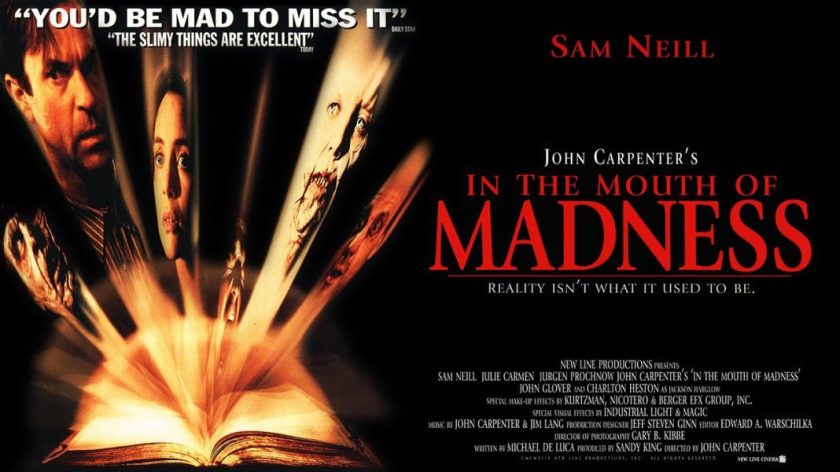
And that brings me to “In the Mouth Of Madness”. Not based in any way on a Lovecraft story but obviously a homage to the Lovecraftian theme of old or elder gods banished from our world long, long ago and always searching, scratching, and clawing for a way back.
I’ve seen the movie at least twice before. I remember liking but not loving it.
Seemed like a good time to give it another chance.
Through the wondrous blessing of the internet and various options I was soon watching a Blu-Ray quality digital copy of the movie.
(Full disclosure: I had again partaken of the excellent herb and I was in a great place to watch a scary movie.)
The premise of the movie is that a best selling horror author has gone missing just before his latest and greatest book was supposed to be completed and delivered. His publisher hires an insurance investigator to look for him.
Some movies, in particular horror or fantasy films, benefit greatly from viewing them not as a faithful reporting of actual reality but as a dream, vision, nightmare, or some other experience that isn’t necessarily grounded in objective reality. This perspective is extremely useful in the full enjoyment and appreciation of some movies and absolutely necessary for others. (“Videodrome” and “Suspiria” come to mind.)
“In The Mouth Of Madness” is best experienced using that perspective. It does have a strong story, but the things the viewer sees and hears, taken at face value, don’t seem to make a lot of sense.
But if you watch the story unfold as if it were a dream or vision from some reality only vaguely connected with our own it becomes something very effective and frightening.
Sam Neill plays Sam Trent, the insurance investigator. Mr. Neil portrays Trent as having an easy-going, almost playful attitude grounded in the belief that practically everything is a con or scam of one kind or another. He’s the perfect protagonist for this story as his seemingly firm grip on objective reality is called into question more than once.
The story wind through a changing landscape of the real and the unreal. It questions the nature of reality, it’s changeability and our ability to perceive those changes. Trent’s grip on the real and the unreal is put to the test more than once.
Back to my initial question: Masterpiece or Mess? I can’t really call it either. It is a good movie and very much worth watching. It’s not a mess as it really works very well. The script, direction, acting, is all very good. But I can’t really call it a “Masterpiece” for Mr. Carpenter.
Why not? Because it pales in comparison to Mr. Carpenter’s two actual masterpieces: “Halloween” and “The Thing”. (One might make an argument for including “Escape from New York” as a masterpiece, but I can’t quite give it that high of a mark.)

